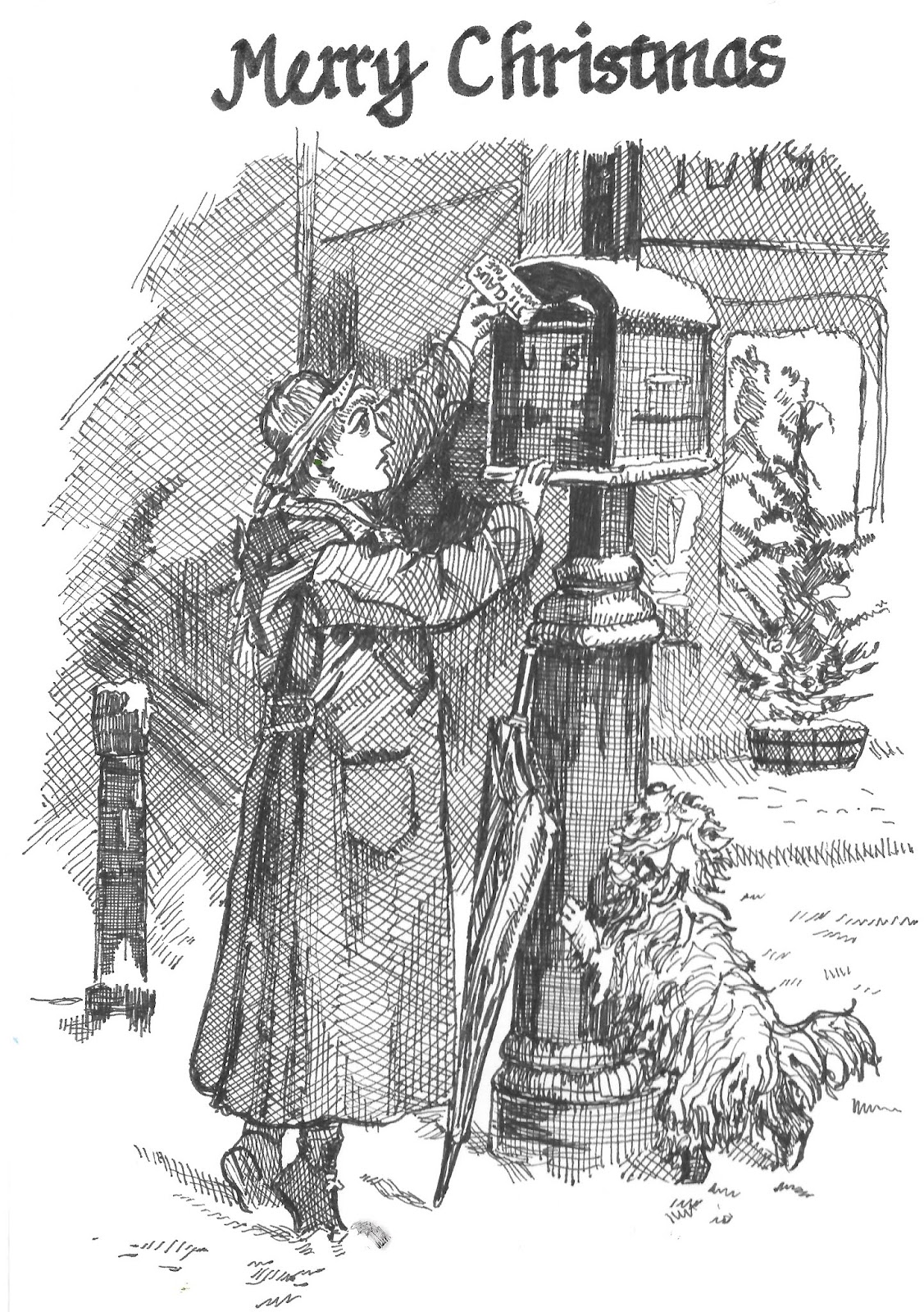
This time I’m not posting about a painting of any type. Since
2016, I’ve been in the habit of drawing, and occasionally painting, my own
Christmas Cards. I don’t sell these, they’re just something I like to do for my
friends and family.
I tend to do most of them with an ink pen. Ink sketching is
something I really enjoy, and I’m probably more skillful when it comes to
sketching with an ink pen than I am when it comes to making cards with
watercolours. For one thing you are working on a very small scale, and I find
it’s far easier to get details right with a pen than with a brush. I really
like the monochrome look, similar to a Victorian engraving, which you can get
with an ink pen too. Which probably explains the subject matter that I like to
choose.
I’m useless when it comes to making something completely out
of my own head. I have to see what I’m sketching. So for a lot of the cards I
take my ideas from. . . well, from original Victorian engravings. Few of these
are actually taken from original Christmas cards, but for the most part they’re
illustrations that have appeared in magazines or books.
Usually I use A5 blank white cards which I buy from a well-known
internet auction site (other well-known internet auction sites are available).
However, earlier in the year my youngest daughter obtained a pack of square
blank cards, a bit smaller than A5, from somewhere, and bought me a pack, so I’ve
started by using these. I scanned the before I inscribed Merry Christmas on
them because it’s possible I may want to use these images again for another
purpose. So, if you’re ready, here’s the first batch of 2020 cards:-
Yes, the traditional bringing in of the Christmas pud. It’s
so huge in this one I can’t help wondering whether the lady’s old man is hiding
inside it. Leaving aside the facetious comments, it can be tricky getting
children’s faces right when you’re working on such a small scale. Still, at
least it helped me get my eye in. Yesterday I worked at a fairly furious pace
to produce 8 cards.
Working like this did at least mean that I had my eye ‘in’
for the next card. This is possibly my favourite of the cards I made yesterday.
It’s such a simple idea (and not mine, as I said earlier), but the silhouette
against the snowy foreground works beautifully, and I also really like the way
the clouds and sky have been rendered. Using horizontal lines like that says
about 1920s to me, but I’m always open to being informed otherwise.
Carol singers are, I find, a fruitful field in which to find
useful images to copy, and in particular, Dickensian era carol singers, be they
well meaning toffs like these, or harmless, humble yokels like in a couple of
the cards I made for 2019.This next design originally dates from 1900. I just really
liked the cheeky faced chap with the mistletoe. To me, that sort of thing is
perhaps just on the right side of twee. Being critical, this is probably my
least favourite of the cards I produced yesterday since, with the girl and her
dog in particular, it’s not brilliantly executed.I enjoy sketching reindeer, and it’s not so hard to find old
engravings and line drawings to work from. This one is part of an illustration
from a Victorian or Edwardian magazine, I would guess, which shows a whole
group of reindeer, of which this is just one. To my way of looking at it, you
really can’t go wrong with reindeer for Christmas cards – pulling a sleigh,
lying down, standing up, whatever you do you can’t go wrong, although the
hatching and cross hatching to produce the fur is always an interesting
challenge.Of course, if it’s true that you can’t go wrong with
reindeer, then it’s even more true that you can’t go wrong with Santa. This
rather old fashioned Santa is just based on a rather old painted illustration
of the lad himself. I was tempted to paint, but if I do paint any of this year’s
cards I’m much more likely to do so on the A5 cards when they arrive.
In past years I’ve always tried to do at least some of the
cards by using more old fashioned representations of the American Santa of wonderful
illustrators like Thomas Nast, and the old English Father Christmas. This is a
more traditional Father Christmas. I don’t know exactly where and when the
original illustration that I copied was made, but the clues that it’s English
are that long, pointy hood, liberally adorned with holly, that he’s wearing,
and the fact that he’s not shown bringing round toys for the kids, but
spreading good cheer with food and drink. In the original, he’s carrying a
large, dead bird by its neck, but I didn’t like this, so I sketched him with a
bottle of falling down water instead.

That’s my first 10 3030 cards, then. I don’t have specific
recipients in mind yet, but every year I produce more cards, and yet every year
there’s requests from my nearest and dearest if they can have one of my cards
to give to someone, and I never have any left over by the end. That’s the way,
uh huh, uh huh, I like it.