Showing posts with label Metro. tram. Show all posts

Monday, 1 January 2024

Last sketches of 2023

Happy New Year! Okay. Christmas Day was 1 week ago. I had many presents – the star of which was a city break in Bucharest coming up in February. Yay. One of the others though was a hardback sketchbook , landscape format, from my oldest daughter and my oldest grandson. The paper isn’t quite as good to work with as the card I’ve been using for the last few months, but there’s something I really like about it. As a result I’ve been trying to do a least one drawing every day in it – starting on Christmas Day I’ve managed ten of them. Here they are:-

Old London Underground Aldwych Station. No reason why this station specifically, although it’s now a station that is no longer used for passengers and hasn’t been since the mid 90s. If you follow the blog at all then you’ll know that I love depicting the Tube, and particularly from years gone by.

Rhino. Again, there’s no personal reason for this, other than I was looking for something completely different from the previous picture. I’d considered painting a rhinoceros in acrylic and even started it just before lockdown in the much missed Artist’s Group sessions. I like rhinos as well although I absolutely would not like to get onto the wrong side of one. It’s just not right that something so big should be able to run faster than we can.

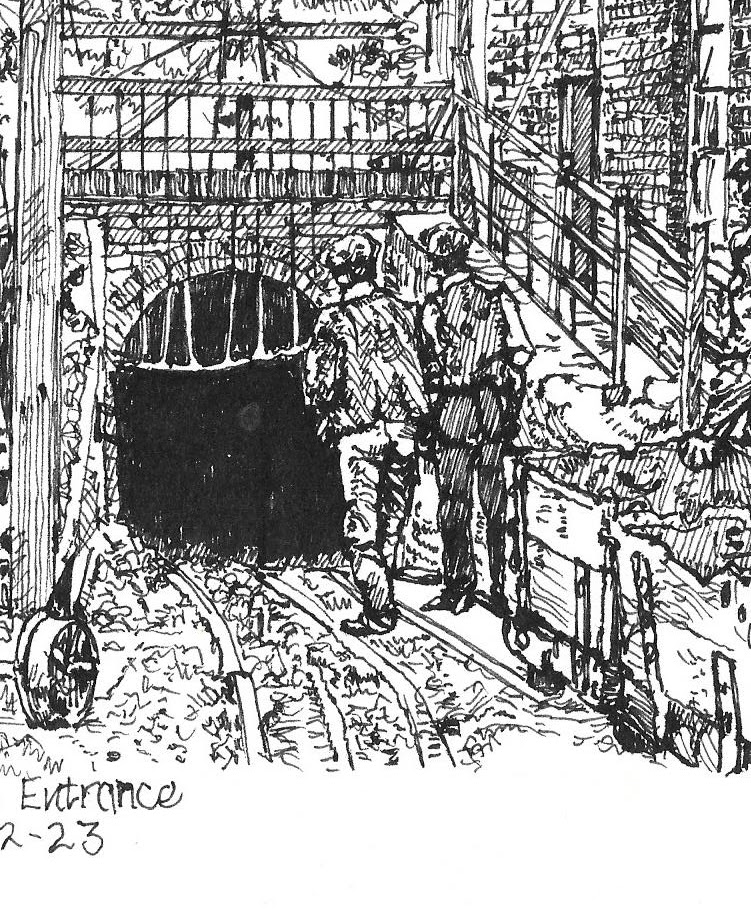
Last summer immediately after the June 30x30 challenge I got into painting a series of direct watercolours based on Victorian photos of workers – chimney sweep – fishwife – street performer etc. I fancied doing some ink sketches of similar subjects, and that’s how I came to do the third picture. The original reference photo of miners walking down to the put entrance is portrait, but my book is too bulky to turn round and use portrait style while I’m sitting on the sofa in the living room, hence it takes up relatively little of the page. I really like the original photo though.

Just over 20 years ago while staying with my mum and stepdad in Tottenham I fulfilled an ambition to see Temple Bar in Theobald’s Park. Temple Bar is a ceremonial gateway to the City of London. It was probably designed by Sir Chrisopher Wren. I say probably because there is no contemporary document which clearly says Wren designed it. However Wren’s son did own the original plans for it, which is pretty strong evidence, I’d say.

Temple Bar stood in the Strand in London. When the Royal Courts of Justice were built it needed to be removed, and to be honest it had been too small to cope with the volume of traffic it the Strand by the middle of the 19th century. Showing remarkable foresight though the City of London authorities insisted that it should be taken down carefully, brick by brick, rather than being knocked to pieces. Each block was numbered, so that it could be rebuilt in another location. Which is exactly wha happened. Within ten years of it’s being dismantled in the 1870s it was bought by Lady Meux, the wife of a brewing magnate and rebuilt in their estate of Theobald’s Park in Hertfordshire. She added two handsome lodges either side of the gate, which were built in sympathetic architectural style and added to the grandeur of the building in its new setting.

In the second half of the 20th century there was a growing movement to bring Temple Bar back to London. I first learned about it when I was quite a young child – already in love with London and its great buildings – and then later from a book on notable British follies. I made up my mind that I would one day visit it in Theobald’s Park.

I only just made it. We visited on a Sunday in July 2003. By this time the money had been raised to purchase Temple Bar, dismantle it, then re-erect it in the shadow of St. Paul’s Cathedral in the City of London. Work actually began the day after our visit. Of course it wasn’t possible to put it back on the spot in the Strand where it had stood, and so the decision was made to place it at the entrance to Paternoster Square. I didn’t get to see it in its new position until the summer of 2004, although my stepfather managed to go to the Opening Ceremony. When I did see it, though, I couldn’t help feeling a little disappointed. For all the fact that it had been run down and dilapidated in Theobald’s Park, it had a kind of grandeur about it. In its current position it is dwarfed by the cathedral and the buildings opposite, and its position just off Fleet Street makes it look like an afterthought.

I’ve drawn it a couple of times before. I painted a copy of an 18th century painting of it to give to my stepfather, which was one of the first acrylic paintings I ever made. I see it every time I visit since it’s hanging on their living room wall. I’m a little embarrassed when I see it because I can’t help thinking about how I could do it differently – better – now. It’s a subject I keep coming back to. This particular sketch is based on a photo taken just before the demolition. I believe that the hoardings on the right were where the Courts were being built, which means that we’re looking westwards.

The next two sketches also reflect my love of old London but particularly focus on my love of public transport. Now there’s a subject I keep returning to. I do love a metro, or subway, or Underground railway. If pushed I will admit that my first concern about a city break destination is always – does it have a metro system and does it have trams? Bucharest, the next destination has both incidentally. This picture number five shows an old entrance to Paddington Underground Station. I rather liked the old taxis.

I have had rather a thing about trams for a long time, although I never got to ride on one properly until 2017 when I visited Prague. In the first three decades of the 20th century London had one of the most extensive tram networks in the world, although the 1933 creation of the London Passenger Transport Board saw the decision to remove trams from the capital. World War II meant that South London did keep its trams until the start of the fifties. Before the introduction of electrified trams there were the horse drawn trams. These had begun running on rails in London in 1870. Horse drawn omnibuses had been running in London since George Shillibeer’s first omnibus in 1829, two years after he had started a pioneering service in Paris.

By the time that the first horse drawn tram ran in London in 1870, the Metropolitan Railway had been running under (slightly) London’s streets for 7 years. The 7th sketch is based on a reference photograph showing a recreation of the early days of the Underground. My surname family only moved to London in the 1930’s – my Grandad Clark moved from Dundee during the Great Depression – but some of my mother’s ancestors were in London from at least the early 19th century. I can’t prove that any of them ever used the Underground in its first decades, but I’d like to think so. My mother’s mother always said that her father had worked on the building of an Underground Line. He was a pipe and joint maker and so my educated guess is that he might have worked on the District Railway extension in the first years of the 20th century.

There’s very much a family connection with the 8th and 9th drawings. The 8th shows a porter in the Covent Garden Fruit and Veg. market in about 1900. Covent Garden was one of the great markets of London along with Billingsgate Fish Market and Smithfield Livestock market. One of my great great grandfathers was a man called Walter William Manning. He didn’t work in Covent Garden but was a Carman in Vestry in Hammersmith – what we would call a corporation dustman. The poor man died of pneumonia when he was 29. His father, John Manning, was a whitesmith, that is someone who made things like post, pans, cooking utensils etc. Now, his father, James Manning, was a Covent Garden porter. He was married in about 1850 in the famous St. Clement Danes Church. In the 1851 census there are quite a few Mannings working as porters in Covent Garden, at least some of whom might have been closer and more distant cousins.

The market was unsustainable in the centre of London, with its narrow streets, and moved to a site in Nine Elms south of the River in the early 70s. Ironically the main building now houses the London Transport Museum. Just under ten years later Billingsgate moved to Poplar to the East. Smithfield, the oldest, still remains.


So, as much as I have a thing about London, and about public transport, and about Family History, I also have a thing about bridges. Bridges of London, even more so. Such a thing is Hammersmith Bridge, subject of sketch number 9. What’s more is that it also has a rather macabre place in my family history. The Bridge in the sketch is the current Hammersmith Bridge. It was designed by the great Sir Joseph Bazalgette and erected in the 1880s. The previous bridge on the site was the first suspension bridge across the Thames. It was designed by William Tierney Clark and opened in 1827. The bridge was very similar to William Tierney Clark’s own 1837 Chain Bridge across the Danube in Budapest – which is still standing and I enjoyed walking across in 2017.

Tierney Clark couldn’t have envisaged how the volume of traffic that the bridge would carry would exponentially increase over the next few decades. The authorities at the time were appalled at the possibility of the bridge collapsing when the annual crowd of over twelve thousand people gathered on the bridge to watch the University Boat Race and rushed from one side to the other as the Oxford and Cambridge boats passed beneath. It’s always struck me as ironic just how important the boat race was to people of Hammersmith and the surrounding area, and how whole families would be passionate supporters of one of the two universities. Despite the fact that there was sod all chance of any of these families’ kids ever getting to either seat of learning, this kind of partisanship was still very common when my parents were kids in the forties and fifties.

Coming back to the bridge, it was during the 1860s when my ancestor John Olive was walking across the bridge to work that he had a fatal hear attack. Even more macabrely his son, James, would have a fatal heart attack while walking 20 years later – this happened on the South Ealing Road. Both had inquests carried out in the venerable Dove Public House in Hammersmith.

Number 10, my last sketch of 2023, shows a pair of London street performers with a ‘barrel’ organ. Mind you, there seems to be less of the barrel and more of the upright piano about this one. In fact it should more properly be called a ‘street organ’. The reference photo I used, judging by the fashions, looks to have been taken in the late Victorian or Edwardian period, one side or the other of the turn of the century. It looks a bit unusual to us today, but you have to remember that ‘free’ public entertainment in the form of the radio was some decades in the future, and the phonograph a luxury that relatively few could afford.

Mind you, this kind of street performance was still not that uncommon by the time that the BBC started broadcasting the world’s first TV service in 1936. Still, it had always been looked down upon as a form of begging, and indeed Charles Dickens who loved the popular theatre condemned it as a public nuisance. After the second World War it practically died out as anything more than a historical novelty.

Having said that though, I do have a very hazy memory of seeing one in the Uxbridge Road in West Ealing in what would have been the late sixties. But in all honesty it was so long ago I’m not sure if it isn’t my memory playing tricks on me, and I’m getting it mixed up with something I saw in an old film or TV show.

Saturday, 19 August 2023

Tube Direct Watercolour 3


This is Euston again. It wasn't one of the original stations on the City and South London Railway, which opened in 1890. The line reached Euston in 1907. The C and SLR was the world's first deep level Underground railway line, and so it really was the first 'Tube'. Previous lines like the Metropolitan and the District railways were 'cut and cover' lines - trenches were dug, and the roofed over. The C and SLR was also the world's first major railway to use electric traction. You can see one of the original cars in the painting. They were underpowered - the first terminus in the City of London was King William Street station. The trains had to negotiate a slight incline up into the station, and often had great difficulty doing so. The station was closed in 1900 when the line was extended to Moorgate.

The City and South London deep level tube lines were Ingenious the way that it was done. Basically it used a machine called a Greathead shield. It protected men hacking away at the tunnels until they could install the circular ring sections which made the tunnel walls. James Greathead built on the earlier work of Marc Isambard Brunel, (Isambard's dad) who invented the first tunneling shield after being fascinated by the way that the shipworm - teredo navalis - lines its tunnels with its own excreta. Mind you, it still took him the best part of 20 years to build the first Thames tunnel - not the least because it kept flooding and the money ran out, dumping him in debtor's prison. Coming back to the deep level tunnels of the London Underground, of course, the thing that really helped was London's clay soil.

So this is another direct watercolour. I'd like to think that these pictures I've bee painting since the 2023 challenge ended wouldn't have been any better if I had sketched them in pencil first. I do really enjoy the challenge of direct watercolour very much. 

No, it isn't all about the money. . . but . . .

 . . . the money from selling pictures and prints is always welcome. I sell a lot more prints than I sell original pictures. The last original that I sold was the 30x30 direct watercolour of the London Underground train at Southgate Station. 

I don't know if I've mentioned this before, but my day job is an English teacher in a local comprehensive school. So the painting and drawing has never been more than a sideline. But when I started my Etsy shop there was some money to be made and so I stared putting all the money I made from the pictures to one side. Since before lockdown I've used this money to provide spending money whenever I go abroad on a sketching trip. I booked my last trip, to Copenhagen, back in the tail end of last year and while my daughter contributed to the flight, everything else - accommodation, spending money and the remainder of he cost of the flight came out of the picture money. And I possibly enjoy these trips all the more because something that I enjoy doing so much has paid for it. 

The next trip scheduled is Lisbon at the end of October. That's all paid for already and I've even got my spending money already - left over Euros from previous trips have accrued quite nicely. Still, the painting pot has dwindled and so it occurred to me that it might well be time to do something that has a chance of selling. Hence yesterday's painting. Here it is:-


Unlike my previous tube picture this doesn't show on old fashioned train visiting a modern platform. No, his is based on a b and w photo from about 90 years ago. It's actually Euston station. Very few underground stations have island platforms like this - an island platform stands between up and down tracks. As for the painting ittself, well, it's another direct watercolour and to be honest I used more or less the same techniques that I used in the photo below. 

The appeal, apart from the fact that I love the tube anyway and I love painting it, is that you can get a far more substantial whack of cash for it in one go than with a print. Now, whether this latest will provide that. . . we'll see.

Thursday, 19 January 2023

Working on my Metros and Trams

 I do like metros and trams very much, which I think I might have mentioned once or twice before. At the moment I'm working on a book about the places I've been to since I started urban sketching, including pictures I've made of various places. I have no idea if anything will ever come of it. Still, as I've been working I've been inserting my sketches, mostly urban sketches. As I've been doing this I've come to the conclusion that some of the metro pictures and some of the tram pictures aren't enough on their own. As a result, I've made extra pictures of a few metros and trams.

Here they are:-

Berlin U Bahn

Prague Metro

Budapest Metro

Madrid Metro

Warsaw Metro

Benidorm - Alicante tram

London Tramlink - Devonald Road