Monday, 24 February 2025

A difference between the 1860s and the 1930s

When you’re making a copy of someone else’s picture, one of the benefits to be derived from it is that you learn a lot about the original while you’re doing it. This makes sense when you think about it. You can’t, well, I can’t copy a picture, or a photograph or even draw from life without looking, looking, looking. I’ve written about my ‘method’ before – which is maybe making it sound more systematic than it really is – of mentally dividing parts of the original into a series of small drawings and reproducing these which eventually combine to form the big picture. Working this way I find does help me to focus on the detail of the separate parts of the picture.


I’m getting a little away from the point I’m going to make. This morning I made a copy of Edgar’s illustration of the fish and frog footmen from Wonderland. Here it is compared with my copy of Tenniel’s illustration of the same scene. The hallmarks of Edgar’s use of the Tenniel original to inspire his work are evident. This is a bit like a mirror image – what’s on the right in Tenniel’s is on the left in Edgar’s and vice versa. The figures are very similar in both, right down to the position of the frog’s legs, and the frock coat worn by the fish. And . . . the fact that the position of the viewer is shifted, so that we are looking slightly down and slightly on he diagonal, compared with Tenniel’s figures. With Tenniel, we the viewers are largely on a level with the figures who are directly in front of us.

Maybe I have an explanation for this. Work with me. For me, it’s the difference between watching a story play out in a theatre on a stage, and watching a story play out on film. Tenniel puts the viewer in the position of the audience in a theatre. Cinema had not been invented when Tenniel made his Alice illustrations. Edgar puts the viewer in much more interesting positions, just as a film director could do using cameras in different positions. Now, I’m not saying that Edgar was consciously trying to be cinematic in his approach. But in the 1930s, when I believe Edgar made his illustrations he was living in a world where cinema had already shown us all different ways of looking at the world.

Well, it’s a theory anyway. What’s not a theory, but a fact is that my admiration for Edgar’s technical skill increases with every one of his illustrations that I copy. You know, I think that I’m pretty decent at copying Tenniel’s work. But if you said to me, well this is what you have to do – you make a mirror image copy, but then you have to also shift the viewpoint upwards, and on the diagonal – well I don’t think I would produce anything decent if I tried to.

For the record his is my tenth copy of an Edgar Thurstan Alice illustration, out of just 21 illustrations he made in total. My eleventh copy is this one below. I think that these latest two copies are probably the best ones I’ve made of Thurstan and it’s probably because I used a nib only half as thick as the 0.1mm nib I used on the others.


Saturday, 22 February 2025

Thurther Thurstan Copies

So, are you in the market for more comparisons between Sir John Teniel’s Alice illustrations and Edgar B. Thurstan’s? I hope so because that’s all I have for you.

Yesterday I made this copy of Edgar’s illustration of Alice falling down the rabbit hole.

Now, I don’t have a comparison here for the simple reason that Tenniel did not illustrate Alice falling down the hole. To me it’s always seemed like a bit of an omission. But then Lewis Carroll himself did not illustrate the scene for Alice’s Adventures Underground. Maybe he just never saw the visual potential. So this is Edgar without the temptation to draw heavily on Tenniel. Now, you have to accept that I’ve done my best with this one but it’s really not a great copy. Edgar’s, you will have to take my word for it, is a technically highly competent piece of work. I do wonder if he was inspired by anyone else’s illustration for this. I haven’t done any research on this yet, so it’s a case of watch this space.

This is a copy of Edgar’s illustration of the Wool and Water chapter of Looking Glass, followed by Tenniel's

Thurstan has once again shifted the position of the viewer, so we’re looking down rather as we did with the railway carriage illustration. If the virtually identical sheep isn’t enough to convince you that we have a deliberate borrowing from Tenniel, then just look at the way that Edgar has taken the kite, spade et al from the side of the counter in Tenniel’s and put them on the front of the counter in his.

Yes, well spotted, there is a big difference between the two. Edgar’s has an open door looking out onto a jetty with the ewe’s rowing boat. I can understand the logic behind the decision to depict the scene in this way. For Tenniel made two illustrations of the chapter, while Edgar had to get as much of it as possible into 1 illustration.

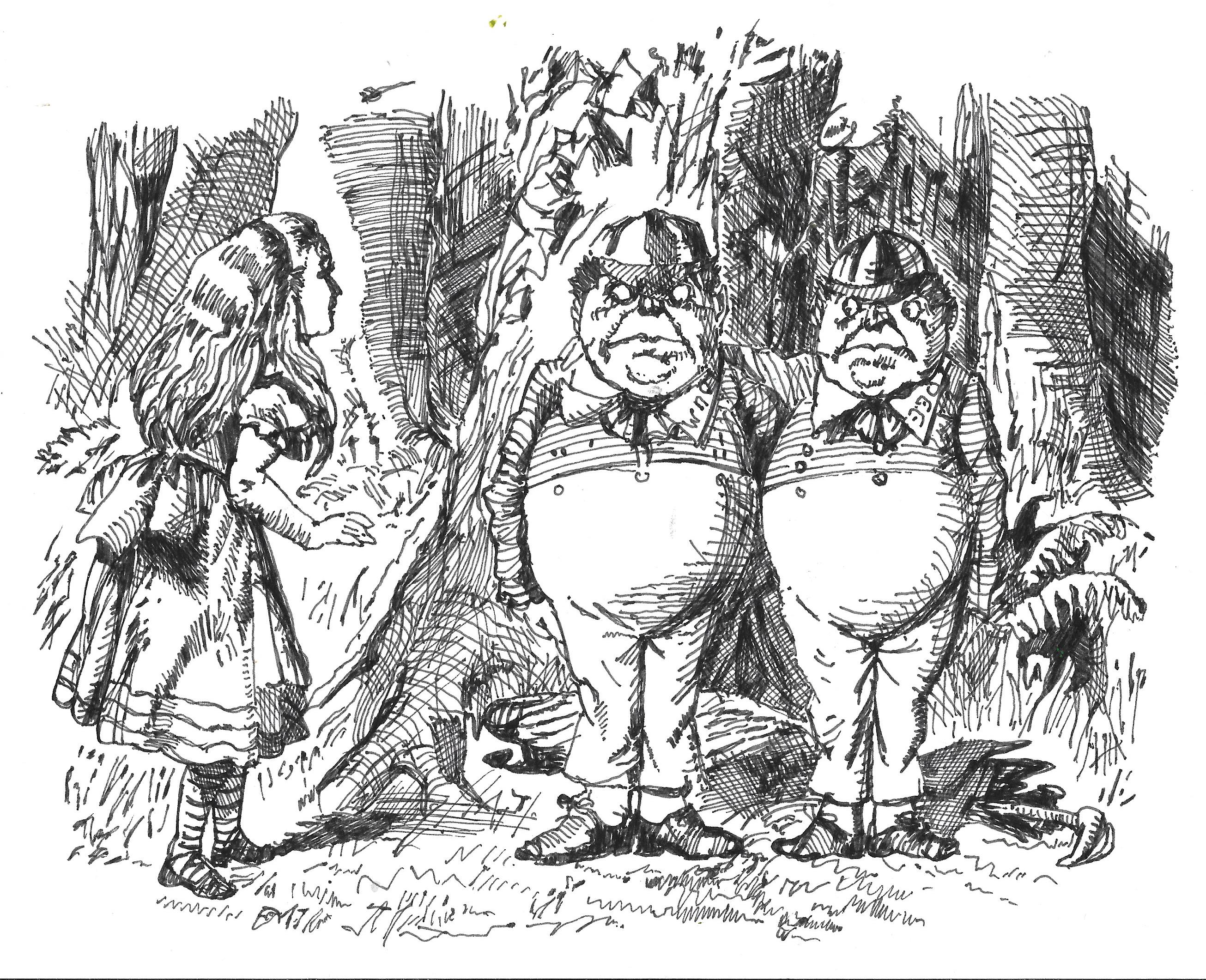
Here's my copy of the second of Edgar’s illustrations that I made today. As if you didn’t know, this is Tweedledum and Tweedledee. Tenniel's is underneath it.


I would say that Edgar is just a little further away from Tenniel than he usually is. The heads are very similar and they are wearing very similar caps. However there are differences in the clothes they wear. Tenniel’s figures wear schoolboy ‘skeleton suits’ that were old fashioned when he drew them. Edgar’s wear rather more modern waistcoats, jackets and trousers. All the time having Alice in her Victorian pinafore dress. Well, as we’ve said before, either Odham’s wanted to go for I can’t believe it’s not Tenniel, or Edgar decided to go that way for his own reasons.

Sunday, 16 February 2025

Copying Thurstan again - easing my way back into sketching

Hi, how are you doing? Me? Well, I haven’t posted anything here since completing the text and illustrations for ‘Alice’s Adventures at the Poles’, no. That’s partly because I haven’t hardly produced anything since. You know how it is – I have to give my new day job the effort and dedication it deserves, and so a lot of the time I just haven’t had the oomph to sketch in the evenings or weekends. I do make a little money out of my art, enough to provide spendsies for my overseas sketching trips, but it’s not my living so I do have the luxury of being able to leave it for a bit when I’m not feeling it.

So up until the last week, the only sketching I’ve done at all recently was during a weekend in Oslo in January. I’ll write about that in a future post – probably. But by Friday just gone I could feel my sketching mojo coming back. But what to sketch? Ideally it would have been nice to copy one of John Tenniel’s Alice sketches – stick with what you know and what you enjoy, innit? But I’ve copied every sketch he made for Alice in the past and I don’t want to do it again. So what was the next best thing? Well, yes, I could have gone for one of the other great Alice illustrators and done another of theirs. I haven’t coped all of Mervyn Peake’s, or Ralph Steadman’s, of Charles Robinson’s etc. etc. But I wasn’t feeling it. I wanted to do a Tenniel style illustration. Which is what led me back to Edgar Thurstan.

In case you haven’t read my earlier posts on this subject I will try to summarise as best as I can. I fell under the spell of the Alice books through an edition, published by Odhams in the 1930s that my grandfather had bought. In my ignorance I had always felt that it contained some of the original Tenniel illustrations. Towards the end of last year I bought a copy of this exact same edition for pennies on ebay, and found out that the 21 illustrations within it were made by one Edgar Thurstan. But they are so clearly inspired by Tenniel’s work that I think my confusion is forgivable. For what it’s worth I think that Odhams wanted the Tenniel illustrations but didn’t want to pay the commission for them to the Tenniel estate. The rights remained with the estate until the 1960s. So I guess they set our Edgar to his work with the instruction to make them as much like the Tenniel originals without breaking copyright as he could.

I copied the Thurstan illustration of Alice in the train carriage  and compared it with my copy of Tenniel's original to prove my point a couple of months ago.

I also commented that the illustrations where Thurstan shows more originality and goes further away from the Tenniel originals are less effective in my point of view. Well, maybe that’s a little unfair. Here’s the copy I made on Friday of Alice meeting the Red Queen in Looking Glass.  Below it is my copy of the Tenniel illustration of the same scene


You’ll notice the more creamy coloured paper of the Thurstan copy. This is because I used my trusty Royal Talens book for it. Not sure why I feel this way but I always enjoy sketching in it. Now, this is similar to the Tenniel in the style – the extensive hatching and cross hatching. The use of trees in the background gives the composition a little similarity. Thurstan, though, has done what he does elsewhere by transposing the positions of the figures. In this one though his Alice is in a different pose to Tenniel’s, curtseying (it saves time). The figures of the queens are quite different too – Thurstan ignores the angularity of Tenniel’s queen, and the fulness of her face seems to owe more to Tenniel’s Duchess or Queen of Hearts. Both wear crowns which look to be inspired by the top of the Queen piece in a standard Staunton chess set. Compare the next picture I copied, also of the Red Queen, with my copy of Tenniel’s:-


Compositionally there’s more similarity between these two. The position of the hands, and the Queen’s staring eyes come to mind. Ironically Tenniel’s is now fuller faced while Thurstan’s is more angular. Yet I have to say that I really like what Thurstan did with the Queen’s arms and hands. Again, he’s made a figure that is more animated than Tenniel’s original.

Okay, so we come to one of the illustrations that I did think inferior to Tenniel’s by some degree. Here’s my copy of Tenniel’s illustration of Alice meeting the caterpillar in Wonderland above Thurstan’s.


This is an interesting one. Again, Thurstan has done his mirror image trick of reversing the positions of the figures and even some of the background details like the smaller mushrooms. The Thurstan hookah is pretty much the same as Tenniel’s. But the big difference, the huge difference, is the caterpillar. Tenniel, to be fair, doesn’t give us a lot to work with in the original. The caterpillar has its back to us and he doesn’t give us much more than the clever use of what might be the forelegs of the caterpillar to suggest the profile of Mr. Punch. So here Edgar really bites the bullet and ignores Tenniel’s caterpillar completely. His caterpillar is a hairy one. And it’s actually pretty well modelled too . . . apart from that face.

You know, I must have been quite inspired by this illustration when I was tiny because the caterpillar has always been one of my favourite characters. But the face of it . . . well, it’s just wrong I’m sorry. It’s too simple, too sketchy and cartoony. It’s out of place here, and it’s a shame because I have come to really appreciate everything else in this illustration through trying to copy it. But it’s surely a case of inspiration failing Edgar when left to his own devices.

Between making the second and third sketches yesterday I tried again to find out anything I could about Edgar ‘E.B.’ Thurstan, and once again I pretty much drew a blank. The only references I could find were for a few works he illustrated for Odhams in the 1930s and the majority of those references were to Alice. And for that matter most of the references to Alice were specifically to the Humpty Dumpty illustration in Looking Glass. So I don’t know. It’s possible, I suppose, that Edgar was not under instruction from Odhams to make his illustrations like Tenniel’s. Perhaps he was under pressure, inspiration failed him and so he decided to use Tenniel’s work as a starting point. Who knows?

Whatever the case, although I know next to nothing about Edgar, I salute him. For the most part, loving your work, sir.

Sunday, 12 January 2025

ALICE'S ADVENTURES AT THE POLES - FIFTY ILLUSTRATIONS COMPLETED

Okay, it is done. Sort of. If you’ve been following the blog then you know that it’s been over a week since I finished writing the first draft of the text of “Alice’s Adventures at the Poles.”. I needed to make two illustrations to the final chapter to take me to my target of forty eight illustrations. I made one on Monday, this rather charming (to my mind) illustration of the mole who is a sweeper in the South Pole Post Office. 

On Tuesday and Wednesday I was writing up reviews of Mastermind and UC for my other blog. By Thursday I had itchy and tired eyes, so I left the other illustrations for yesterday.

Now, this meant I only needed to make one yesterday. Which I did. This mean that I had here illustrations for chapter 12. Still, when I had made the forty eighth that meant the last chapter only had 3 illustrations. As it is, chapters 2,3 and four only have 3 illustrations each, but since then every chapter has had at least four. So I did what will be the illustration at the end of chapter XII. Then I thought – forty nine. Just one away from fifty. So I drew an illustration of the octopuss, a recurring character who makes no fewer than three separate appearances in the story. Here’s the illustrations.


So, am I done with the making, then? Well, no, not quite. The text needs editing and possibly revising slightly. Then there’s the illustrations. I’ve tried to be quite hard on myself as I go along, rejecting and re-doing where necessary. I redrew the second illustration in the book because the original was on cream coloured paper, for example. But there are still a least a couple of illustrations that I think I need to redo. It seems a waste to come this far, and then accept pictures where I think I might do better.

In the coming week, I guess I’ll start to think about my feelings about the whole project, and look to get this down on paper by the end of the month (I’m away on holiday next weekend.)

Saturday, 4 January 2025

ALICE'S ADVENTURES AT THE POLES - NARRATIVE FIRST DRAFT COMPLETE!!!

Okay. Let’s recap. I started writing my own Alice adventure in September, around the 11th. It took me until the beginning of December to write and illustrate 6 chapters. The speed with which I wrote the chapters varied – I can remember taking the best part of three weeks on one of them, but generally they were taking between 10 days and a fortnight. Then we got to December.

The last time I posted, six days ago I had completed Chapter X. I promised myself that I would take it rather easier on Chapter XI and my actual words were “I have no intention of rushing through the chapter at full tilt again,”. Yeah, right. I finished writing Chapter XI on Wednesday, New Year’s Day, and immediately started to write Chapter XII. I produced two illustrations for Chapter XI by Friday evening, and made two more this morning. Then I finished writing Chapter XII. Which means, dearly beloved, that I’ve finished writing the whole of the narrative. Well, the first draft, anyway.

Okay, so I was always going to read and revise the whole story again anyway, but the speed with which I’ve completed the last couple of chapters worries me a little, so I definitely need to go through them.

For the record, then. The current length of the novel is just over 46000 words – which is quite a bit longer than Alice in Wonderland. Which is absolutely not a criticism of Carroll’s book, which is above criticism, just a comparison.

I have completed 45 illustrations, but not yet illustrated chapter XII. My target for the whole novel was 48.John Tenniel made 42 illustrations for Wonderland (and another 50 for as Looking Glass)

My first draft has 19 poems in it. I think that there are 19 poems in Wonderland and Looking Glass combined – 11 in the first book and 8 in the second.

My first draft does also include 180 footnotes which add just over 11,000 words. Self indulgent – probably but writing them gave me a great amount of pleasure.

I don’t think I want to write about what I’ve got out of writing the story and making the illustrations until I’ve illustrated the last chapter, so in the meantime, here’s he illustrations to chapter XII:-


Sunday, 29 December 2024

Famous Last Words

I posted on Thursday – Boxing Day – about the ridiculous speed with which I wrote and illustrated chapter IX of Alice’s Adventures at the Poles. My plan was that I would take it more easily after that. Famous last words. I sat down on Friday morning before work, and wrote almost 1000 words of Chapter X. I wrote the rest of the chapter on Saturday, made one illustration for the chapter, then wrote the notes for it and made the three illustrations I needed to complete the chapter yesterday. So in the space of a week I’ve gone from 2/3 of the story completed, to five eighths.

I mentioned the notes for each chapter. I’m not entirely sure whether I’ve mentioned them before. In case I haven’t, when I’ve completed each chapter I like to write a set of bullet notes accompanying it. The notes can cover a variety of subjects. Originally I just wanted to explain the significance behind some of the references in chapter I, and what they mean in terms of Lewis Carroll’s stories and also the real-life Alice Liddell. This soon expanded to the more general historic context to some of the incidents in chapter 1. Then I decided it might be nice to explain some of the choices I made when making the illustrations. Then I though it was only fair to acknowledge where I have been influence by the Alice books in the choices I’ve made for the narrative. . . and so on. While I wouldn’t say that I’ve necessarily enjoyed making the notes more than writing the narrative or making the illustrations, making the notes has become an intrinsic part of the whole act of creation for me. And yes, if you push me, it plays to the natural show off within me that is never that far from the surface – I suppose it is me saying – Look how clever I’ve been! – when I’ve written something that I think deserves it.

Well, I’m two hundred and fifty words into chapter XI which will be the penultimate chapter and I know the broad sweep of what is going to happen in it. I have no intention of rushing through the chapter at full tilt again, but we’ll just see how it goes.

Meanwhile, here’s the illustrations to Chapter X


Thursday, 26 December 2024

Three Quarters of Alice's Adventures At The Poles Completed

One of the nice things about writing a story in 12 chapters of roughly the same length is this. When you’ve written 8 chapters, then it’s two thirds done. However you only have to write one more chapter and then you’re three quarters done. Well, as I’m sure you’ll have guessed, I completed Chapter 9.

The text has picked up great momentum. This can happen for a number of reasons when you’re writing, just the same as your writing can lose momentum for different reasons. I don’t want to go into too much detail, because I don’t want to start summarising the plot. But when you’re writing, especially in the picaresque style I’m using for my Alice story, you can find that you’re writing a character whom you really enjoy writing about and then it becomes easy. So the episode with the character in question was only ever planned to go on for about 1000 words, or a quarter of Chapter IX but as written it now takes about 3000, or three quarters of the chapter. I finished writing the text of the chapter on Christmas Eve, and this meant that I wrote the whole thing across three days, Sunday – Tuesday. I also made the first illustration. Yesterday was Christmas Day, which is sacred family time not to be sacrificed on the altar of illustration.

Today, though, the opportunity presented itself, and I have made three – count ‘em – three more illustrations. This makes four for the chapter and 37 for the first 9 chapters, 1 more than the target. So if, for the sake of argument, I manage to produce a further 11 illustrations for the last 3 chapters then I’ll hit my target of forty eight.

It certainly seems doable. However I’m not putting a timescale on it. I’m back in work tomorrow and that could well change things. I’m also aware that it is just as easy to lose momentum as to gain it. It’s a tricky thing, getting the balance right. When the force is with you and the words are zooming out of your typing fingers at 90mph its natural to want to keep it going, but trying to keep going at this rate when you’re not feeling it any longer can be counter productive. On the other hand, while you don’t want to force it there is something to be said for the self discipline necessary to bring yourself to write at least a little every day. Sometimes I’m not feeling it, and even when I’ve written my target of , let’s say, a hundred words for this short session I’m still not. But there are times when this exercise of adding another 100 words to the story has really kick started things and got the creative juices flowing.

Well, anyway, here’s the illustrations for chapter IX